
Ecosystem Unification: The Third Dimension of Measurement Maturity
Jaiah Kamara, Founder, Signal to Summit | 7 Years Building Measurement at Best Buy Ads | Industry Analyst and Advisor to Retail Media Platform Providers
Part 3 of 3 in the Signal to Summit Measurement Maturity series.
The Signal to Summit Measurement Maturity series introduced three dimensions that determine whether proof reaches the person making the spending decision. Proof capacity was the first: what you can actually demonstrate, and to whom. Operational delivery was the second: whether that proof arrives in the right format, at the right moment, in the hands that decide. This paper covers the third dimension, ecosystem unification.
A brand does not buy one corner of your network. They run sponsored products, offsite display, CTV, in-store, maybe on a social media platform, and they expect you to tell them what all of it did together. That is where most retail media measurement breaks. You can have real proof and fast delivery on the channels you have figured out, and still have no answer when a brand asks how their spend performed across the full journey. Ecosystem unification is the dimension that decides whether your measurement holds together across the whole portfolio, or only works one channel at a time.
If you have not read the series introduction, Measurement Maturity: A Framework for Retail and Commerce Media, that is the entry point to the full framework.
If you missed the earlier dimensions, start with Proof Capacity: The First Dimension of Measurement Maturity, then Operational Delivery: The Second Dimension of Measurement Maturity.
- The Cost of FragmentationThree levels of hidden cost: double-counting you cannot see, a measurement ceiling lower than you think, and non-endemic revenue you cannot access
- Five Levels of Ecosystem UnificationFrom Isolated Systems to The Customer Journey as Competitive Advantage, scored per ad product
- The Portfolio QuestionWhich connections are missing, and which missing connections are costing you the most
- The Benefit of Getting Unification RightAnswer the question every major advertiser is actually asking, and unlock revenue that only exists when brands can connect
- The Proof ChainThree papers, three dimensions, one conclusion: the chain breaks at the weakest link
THE COST OF FRAGMENTATION
Fragmentation is a serious data problem, and anyone who has worked in data knows it is one of the most critical to solve. In retail media it is also the one that quietly caps everything else. You cannot dedupe attribution across overlapping exposures, you cannot connect a customer journey across channels, and you cannot partner with brands who need a unified view, when your data lives in systems that were never built to talk to each other. The cost operates at three levels, each harder to see than the last.
First, you are double-counting and you may not know it. A brand runs sponsored products and onsite display, and both systems report a conversion from the same shopper on the same transaction. Without a connected identity layer telling you that was one journey, you counted it twice. When the brand or agency dedupes on their side, your numbers shrink, and that is worse than reporting lower numbers from the start, because you lost the argument after appearing to win it.
Second, your measurement ceiling is lower than you think. If your loyalty program penetration is 40%, then 60% of transactions are already invisible to deterministic measurement, and that gap widens once you account for ad products running on different identity systems with different match rates. Onsite might match well, but offsite match-back typically runs through a partner at 40 to 60 percent, CTV runs lower than that, and social activations often come back as cohort-level aggregates with no individual match at all. The journey you are trying to prove is structurally invisible for a meaningful share of the shoppers who actually experienced it, and that ceiling does not move until the identity infrastructure underneath it changes.
Third, you are locked out of non-endemic revenue at scale. When a financial services company or an auto brand wants to advertise on your network, they bring budget but no transaction in your system, and your entire measurement architecture is built around matching ad exposure to purchase. No purchase means no proof path. Non-endemic is one of the fastest-growing revenue opportunities in retail media, and a fragmented ecosystem with no alternative measurement path cannot access it at scale.
These costs compound at the portfolio level. Your largest advertisers are the ones buying across the most formats, and they are not asking for individual ad product reports, they are asking what the network did for their business. The more formats a brand buys, the more exposed they are to your fragmentation, which means your biggest revenue relationships carry the most risk.

And the urgency is commercial. Holding companies are building normalization infrastructure to evaluate performance across retail media networks consistently, and the networks whose data connects cleanly into those frameworks get considered for the largest allocations. When your data arrives fragmented, deduplicated differently by each ad product, with identity coverage gaps that compress under external scrutiny, you get discounted before the evaluation even begins. Fragmentation is not just an internal measurement problem. It is how you show up in the room where the biggest budget decisions get made.
FIVE LEVELS OF ECOSYSTEM UNIFICATION
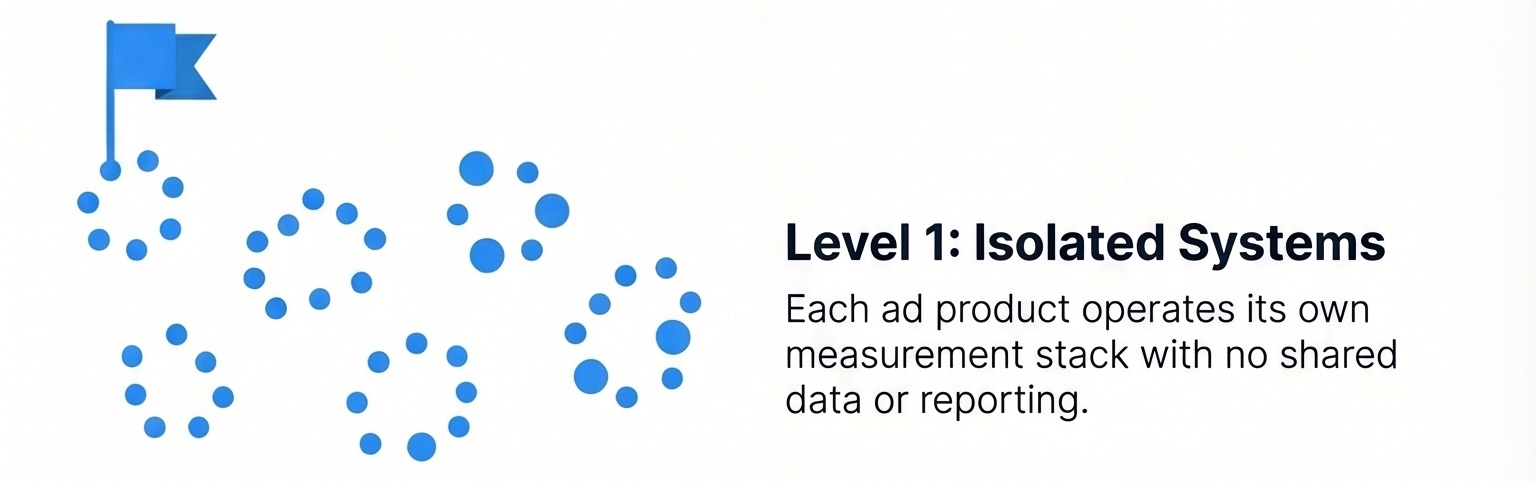
Level 1: Isolated Systems. Each ad product on your network operates as a separate measurement island. Sponsored products, onsite display, and offsite programmatic each report through their own system, and if you have CTV, in-store, social, or paid search, each carries its own reporting interface, identity backbone, and methodology. When a brand asks how their investment performed across your network, the answer is a folder of separate reports, one per ad product, each telling its own story with no connection to the others.
The customer journey that actually happened, the shopper who saw a CTV ad, searched onsite, clicked a sponsored product, and converted, is invisible as a journey. Each system claimed a piece of it and nobody connected the pieces. You have activity data, not a story.
Why: Each ad product was built or integrated independently, often by different teams, using different vendor infrastructure, on different timelines. There was no architectural decision to connect them because the priority at each stage was getting the ad product live and generating revenue, not building measurement infrastructure that would connect it to everything else. The identity systems underlying each product were chosen for that product’s needs, not for interoperability: sponsored products run on your loyalty backbone, offsite on a partner’s device graph, CTV on a streaming partner’s identity system, social on aggregated cohorts. These systems were never designed to speak to each other, and at Level 1, nobody has tried to make them.
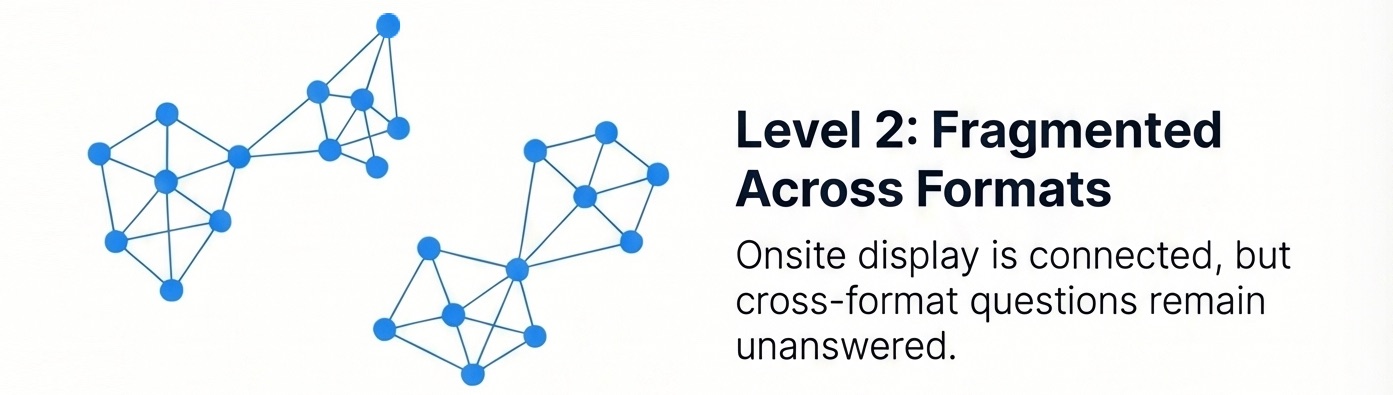
Level 2: Connected Within Formats, Fragmented Across Them. You started connecting measurement within some ad product categories. Your onsite formats, sponsored products and onsite display, share a common identity backbone and report through a consistent methodology, so when a brand runs both, you can tell a coherent onsite story. But the moment the conversation expands to offsite, CTV, or in-store, you are back to separate systems with separate logic. The cross-format story breaks at the boundary between onsite and everything else.
You also started building your own data connections to the retail enterprise. Your measurement team has access to POS data for some reporting, and loyalty transaction data feeds into your onsite attribution model. But those connections are partial and manual, built to serve specific reporting needs, not to create a unified data foundation across your full portfolio.
Why: Connecting measurement within a format category is architecturally simpler than connecting across them, because onsite formats share a common first-party data environment where shopper identity, transaction data, and ad exposure data all live close together. Offsite measurement requires matching an external impression back to an in-store or online transaction, which introduces a partner-dependent identity layer with its own match rate and limitations, and CTV and in-store each add another layer on top of that. Each cross-format connection is a different identity problem, and at Level 2, the organization has solved the easiest one but not the harder ones.
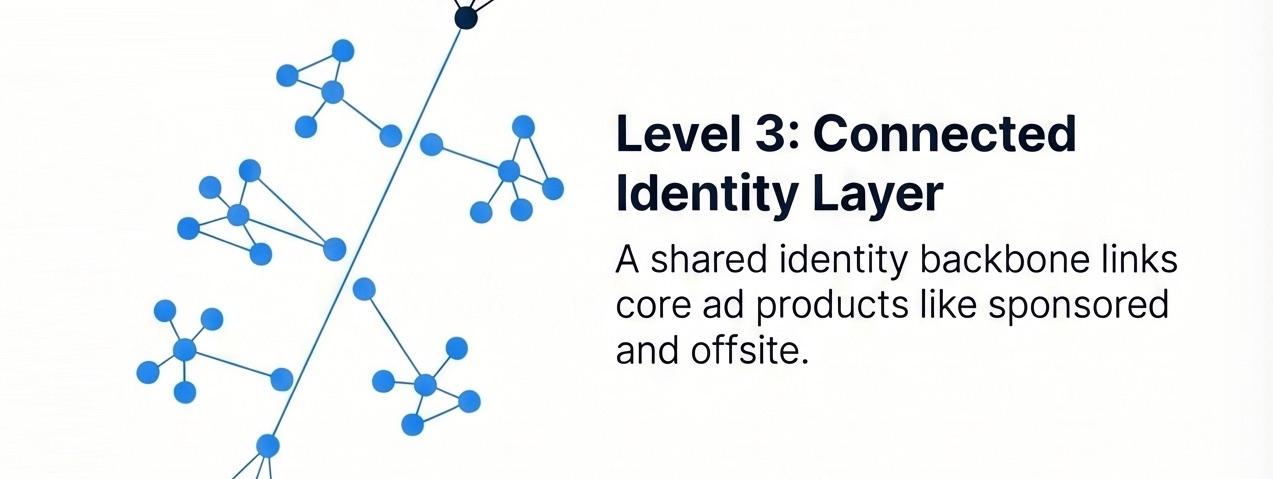
Level 3: A Connected Identity Layer Across Core Formats. You built or integrated an identity resolution layer that connects your core ad products under a common shopper identity. When a shopper is exposed to a sponsored product and then an onsite display ad and then converts, your system recognizes that as one journey, not three separate attribution events. Cross-format deduplication works for your core portfolio, and the double-counting problem that defined Levels 1 and 2 is largely resolved for the formats you prioritized.
You can answer the cross-format question for those formats. A brand running sponsored, onsite display, and offsite can get a deduplicated view of performance that survives basic agency scrutiny. The portfolio story holds for the formats in the connected layer, but CTV, in-store, social, and non-endemic are still outside it, running on separate identity systems. The connected layer covers the revenue you have today, not the formats you are building toward.
Why: Building a connected identity layer requires choosing an architectural approach and investing in the infrastructure to implement it: first-party loyalty data as the deterministic backbone, an identity resolution provider to extend coverage to non-loyalty shoppers, and clean room infrastructure for the walled garden connections that cannot be solved with a direct integration. These choices were made for the core ad products because that is where the measurement pressure was highest. CTV identity runs through the streaming partner’s system and requires a different integration approach, in-store attribution requires connecting physical presence signals to the loyalty backbone, and social platforms operate closed identity environments where clean room collaboration is the only path. Each extension of the connected layer requires a separate architectural decision and a separate investment.
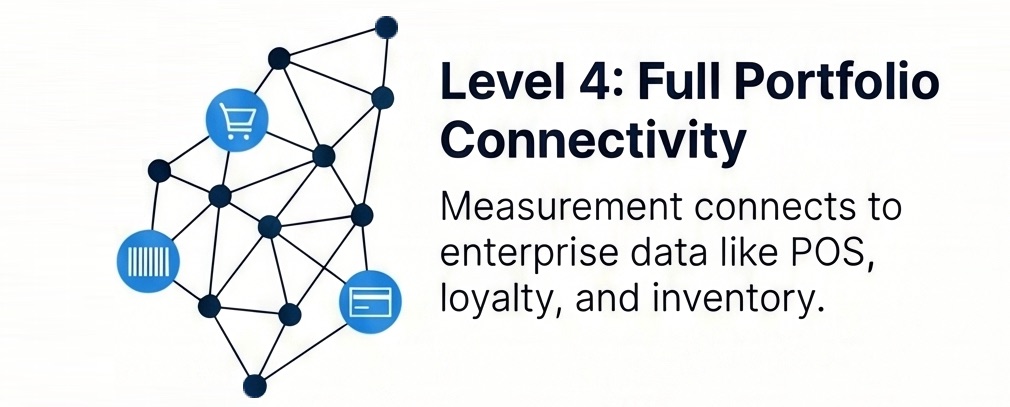
Level 4: Full Portfolio Connectivity with Enterprise Data Integration. Your identity layer covers your full ad product portfolio, from sponsored and display to offsite, CTV, paid search, social, and in-store. The customer journey is visible end to end for the shopper segments your identity infrastructure can reach, and cross-format deduplication works across formats, not just within your core. When a brand asks what the network did for their business, you have a connected answer that spans everything they bought.
And the measurement is now connected to the broader retail enterprise. POS data, loyalty transaction data, inventory data, and category management data feed into your measurement infrastructure through real data pipelines, not manual exports. Browse behavior and conversion paths from your e-commerce platform connect ad exposure to the full purchase journey, from exposure through consideration to conversion, not just the last-click event. That enterprise data connection changes the proof you can produce: you are not just measuring ad-to-purchase, you are measuring ad-to-business-outcome across the full retail data ecosystem.
Non-endemic advertisers have a proof path. Brand lift measurement, audience qualification scoring, foot traffic attribution, and third-party conversion tracking give advertisers without a purchase in your system something credible to evaluate, and the methodology is productized and transparent rather than constructed ad hoc for each request.
Cross-brand partnerships have a proof path for the first time. The same clean room infrastructure that connects walled garden platforms also lets two first-party data environments collaborate without either side exposing raw data. A brand can co-fund an activation with a complementary brand, or partner directly with the retailer on a shared audience, and both sides receive measurement on the outcome. At Level 4 this works, but it is still a deliberate, configured engagement. Each partnership requires your team to stand up the clean room connection, align on the measurement question, and produce the result. The capability is real, but the effort per partnership is high.
Why: Full portfolio connectivity at Level 4 required solving the identity problem for each format independently and then connecting those solutions into a coherent orchestration layer, because no single identity technology covers 100% of shopper exposure. First-party loyalty data is the deterministic backbone for known shoppers, an identity resolution provider extends probabilistic coverage to unknown shoppers on the open internet, open internet identity frameworks handle CTV and programmatic, and clean room technologies enable collaboration with walled garden platforms where no external identifier can penetrate. The orchestration layer coordinates across all of these, recognizing that the same shopper may appear in multiple identity systems and that the goal is journey visibility, not perfect one-to-one matching.
Enterprise data integration at Level 4 required building real data pipelines between the retail media measurement infrastructure and the retail enterprise systems that have historically operated separately. POS data was not built for advertising measurement, and loyalty data was not built for campaign attribution. Connecting them required both technical infrastructure and organizational alignment between the retail media function and the broader retail technology and data teams.
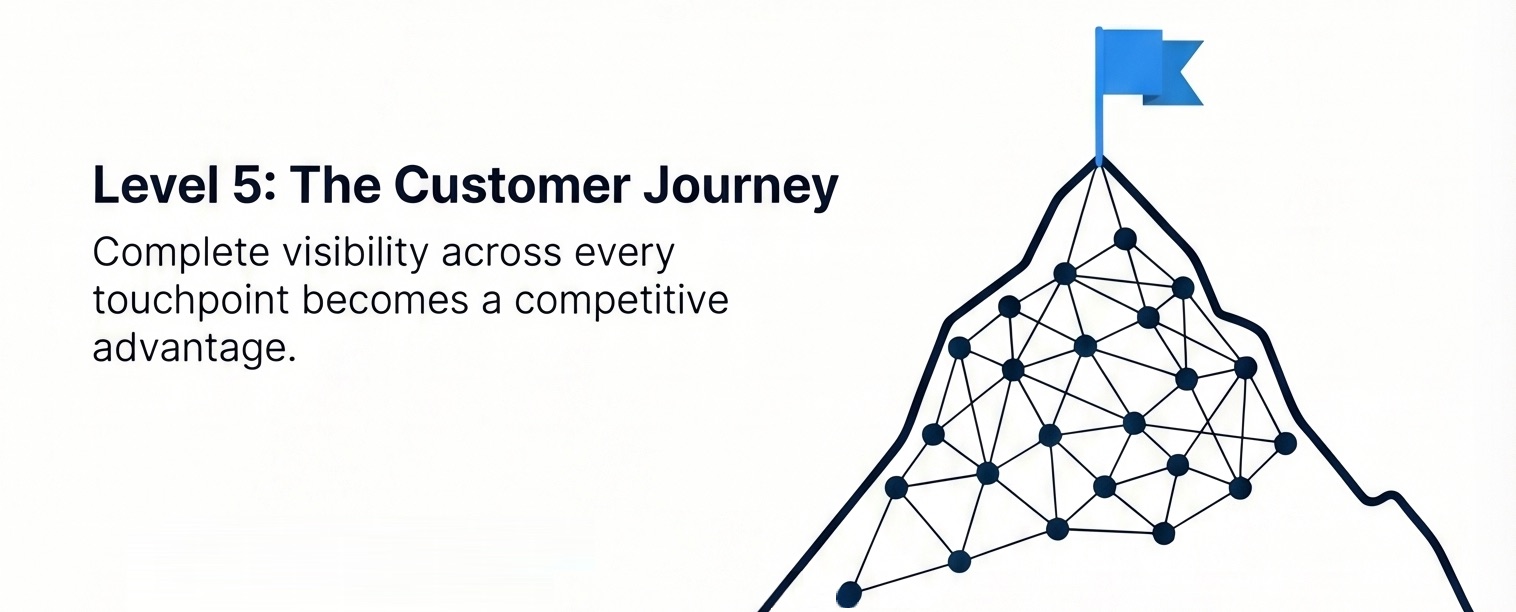
Level 5: The Customer Journey as Competitive Advantage. Your ecosystem is unified in the way that matters to the brands spending the most money with you. Not just connected across ad products, but connected across the full retail enterprise data environment and designed to interoperate with the external frameworks your audiences use to evaluate performance.
A brand can see the complete journey their advertising drove, from first exposure across any format on your network through browse behavior, consideration signals, and conversion, for every shopper segment your identity infrastructure reaches. The measurement is not just internally consistent, it is externally portable. It enters a holding company’s cross-channel model without requiring translation, and it survives the normalization layer an agency applies when comparing your performance against other media investments.
For non-endemic advertisers, the proof paths are as mature as the transaction-based measurement your core advertisers rely on. Brand lift, audience qualification, and alternative attribution methodologies are productized, documented, and transparent. A financial services brand or auto manufacturer can evaluate your network on the same rigorous standard as a CPG brand, and the revenue opportunity non-endemic represents is fully accessible because the measurement infrastructure supports it.
Cross-brand partnership is productized at the same standard. The clean room collaboration that required deliberate configuration at Level 4 is now a repeatable capability, not a custom engineering project per partner. A brand can run a co-funded activation with another brand on your network, and both receive deduplicated, clean-room-mediated proof without your team rebuilding the connection each time. The partnership infrastructure is documented and self-serve enough that sophisticated advertisers and their agencies can engage it directly. This is the unified view that multi-brand advertisers and holding companies expect from the networks operating at the top of the market.
Why: Level 5 unification is the result of treating identity orchestration and enterprise data connectivity as products, not infrastructure projects. The architecture was designed from the beginning for external consumption, not just internal reporting. The identity orchestration layer is documented, its coverage rates are published, and its limitations are transparent, so an agency can evaluate the methodology rather than taking your word for it. The enterprise data connections were built with API access and clean room interoperability in mind, so external partners can engage with the data in their own environments rather than waiting for your team to produce a custom export.
Amazon is the clearest calibration point for what Level 5 looks like in practice. The combination of first-party purchase data at scale, closed-loop measurement across onsite and offsite formats, DSP infrastructure connecting retail and brand advertising, and streaming and entertainment data creating additional identity signals produces a unified measurement environment that most networks are not close to replicating. The standard is not Amazon’s scale. The standard is the architectural principle: proof capacity, delivery infrastructure, and ecosystem connectivity designed as one integrated system rather than assembled from parts.
THE PORTFOLIO QUESTION
The portfolio question for ecosystem unification is different from the first two dimensions. For proof capacity and operational delivery, the question is which ad product is your weakest link. For ecosystem unification, the question is which connections are missing, and which missing connections are costing you the most.
The connections that matter most are not always the ones that are hardest to build. Your biggest multi-format advertisers are running across your highest-revenue ad products, so if the connection between those specific ad products is broken, the fragmentation cost is highest exactly where your revenue concentration is highest. That is the first place to look.
The second place to look is where your growth plan points. If your next two years depend on scaling CTV and non-endemic, and neither has a connection to your identity layer or enterprise data, then your growth plan and your unification maturity are pointing in opposite directions. You are counting on revenue from the formats least equipped to prove their value.
And the third place to look is what your most sophisticated partners are asking for that you cannot yet give them. A holding company asks for clean room access you do not have. A brand asks for a deduplicated cross-format view your system cannot produce, or wants to run a co-funded activation with a partner brand and needs both sides measured through a clean room you have not built. An agency asks for API access to your identity-resolved data and the documentation does not exist. Those requests are telling you exactly where your unification gaps sit in the hierarchy of what the market requires.
THE BENEFIT OF GETTING UNIFICATION RIGHT
Getting ecosystem unification right has four consequences that the first two dimensions cannot produce on their own.
First, you can answer the question every major advertiser is actually asking. Not “how did sponsored products perform.” Not “what was offsite ROAS.” What did your network do for my business. When your ecosystem is unified, that question has a credible, connected answer that spans every format the brand activated. The portfolio story is coherent because the data underneath it is coherent, and that coherence is what earns the budget conversation that moves beyond individual ad product negotiations into enterprise-level partnerships.
Second, your network becomes interoperable with the infrastructure your most valuable audiences are building around you. Holding companies are building normalization layers to evaluate retail media networks consistently. The networks whose measurement connects cleanly into those layers get included in the models that move the largest allocations, and the networks that require manual work to normalize get discounted or excluded. Unification at Level 4 and Level 5 is not just a measurement quality improvement. It is an entry requirement for the budget tier that changes the scale of your business.
Third, your enterprise data becomes a competitive differentiator, not just an internal asset. When your measurement infrastructure is connected to POS data, loyalty transaction data, inventory signals, and browse behavior, the proof you can produce is grounded in the full retail data environment, not just the advertising data layer. That depth of proof is structurally unavailable to networks that have not built the enterprise data connections. It is the clearest version of the measurement advantage that a retailer with first-party data should have but most do not yet fully realize.
Fourth, you unlock revenue that only exists when brands can collaborate. Cross-brand partnership is a category of spend a fragmented network cannot access at all, because it depends on connecting two separate first-party data environments through a clean room without either side exposing raw data. When that infrastructure is in place, a brand can co-fund an activation with a complementary brand, or partner directly with you on a shared audience, and both sides get measurement on the outcome. That capability opens co-funded budgets, joint activations, and multi-brand programs that never appear on a network that cannot connect its own systems, let alone two companies’ systems to each other. It is not a better version of revenue you already have. It is revenue that does not exist below this level of unification.
THE PROOF CHAIN
Three papers. Three dimensions. One conclusion.
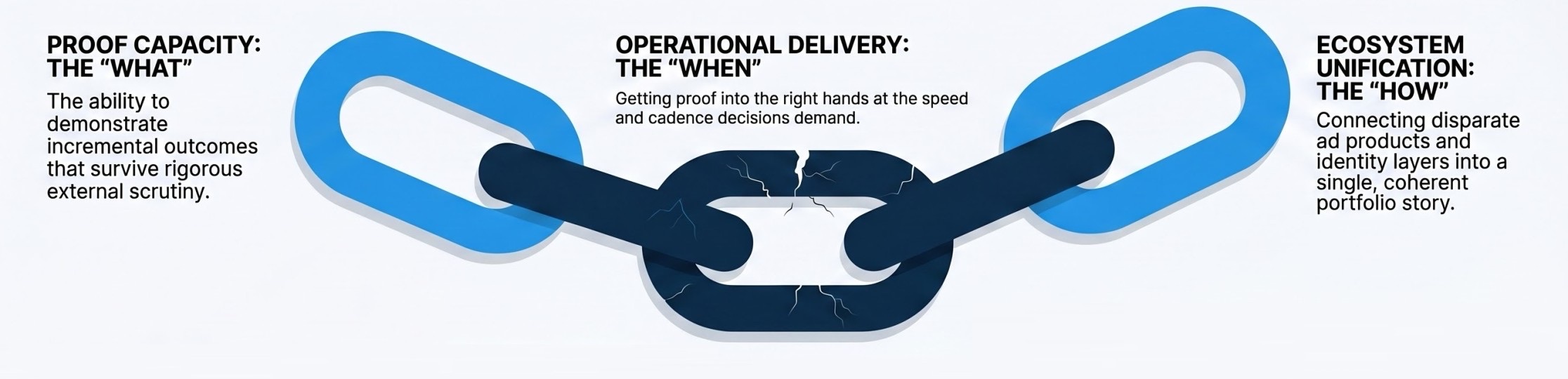
Proof capacity determines what you can demonstrate and to whom. Operational delivery determines whether that proof reaches the person making the spending decision in the format and at the speed their decision requires. Ecosystem unification determines whether both can function across your full channel portfolio or only for the ad products you built first.
These dimensions do not average. The chain breaks at the weakest link. A network at Level 4 on proof capacity and Level 4 on operational delivery but Level 1 on ecosystem unification does not have a strong measurement story. It has a strong measurement story for one ad product at a time, and a fragmented story the moment a brand asks about the portfolio.
That is why this framework exists as three separate papers rather than one. Each dimension requires its own honest assessment, per ad product, scored independently. The gaps that are easiest to see, slow delivery, borrowed proof, are not always the gaps doing the most damage. The gap that is hardest to see, disconnected systems that look fine individually and break under cross-format scrutiny, is often the one sitting underneath your most important revenue relationships.
Find your weakest link. That is where the highest-leverage investment lives. Not the dimension where you are strongest. The one where the chain is closest to breaking.
Why I Do This Work
I’m Jaiah Kamara, founder of Signal to Summit.
I spent fifteen years in retail, seven of those years in central leadership roles building the reporting and measurement infrastructure at a top-ten retail media network. I built systems that drove advertiser confidence: reliable reporting infrastructure, decision frameworks that empowered action, operating models that ensured data quality, and cross-functional ways of working that aligned sales, strategy, and measurement around shared truth.
I now work as an industry analyst and advisor helping retail and commerce media platform providers and operators move this industry forward. I commission structured research that fills the gaps published frameworks miss, and I publish what I find so the industry can move together.
The Signal to Summit Difference
Most of my work in retail media was not about strategy decks. It was about building systems that drove advertiser confidence and organizational readiness. The Signal to Summit Measurement Maturity Framework is one of those systems, made portable for the industry. The ecosystem unification dimension you just walked through completes it.
If you are a retail or commerce media operator, platform provider, or holding company partner, and any of what you read above lands on something you are navigating right now, the path to talking is short.
Keep Reading
April 28, 2026
Operational Delivery: The Second Dimension of Measurement Maturity
Defined by whether your proof gets there in time to matter.

April 21, 2026
Proof Capacity: The First Dimension of Measurement Maturity
Defined by what your measurement can demonstrate, and to whom.
April 14, 2026
Measurement Maturity: A Framework for Retail and Commerce Media
Defined by what you can prove, deliver, and unify.