Measurement Maturity: A Framework for Retail and Commerce Media
Jaiah Kamara, Founder, Signal to Summit | 7 Years Building Measurement at Best Buy Ads | Industry Analyst and Advisor to Retail Media Platform Providers
WHY THIS EXISTS
When I first started as a leader in measurement at Best Buy, it actually predated the formal launch of Best Buy Ads as a business. Back then I had two analysts reporting to me, and we were responsible for one thing: producing reporting for onsite display.
Over the following seven years and the formal launch of Best Buy Ads, the advertising reporting portfolio got built under our department piece by piece. Onsite display. Sponsored products. Paid search. Offsite display. Social. Affiliates and influencer. In-store. YouTube. Brand lift studies. Several of those channels were coming from separate departments entirely, and our team was responsible for pulling the measurement together and delivering it to the client. Through that journey, my job, along with the other measurement leaders and product partners I worked with, was to build a measurement system that spanned almost the entire advertising portfolio. We were truly trying to build something from scratch inside a fragmented ecosystem that was never originally designed for what you would call ideal today.
Together we built something I am very proud of. The feedback and enthusiasm I received from internal partners and from clients was real. But one thing I always wanted to understand was where we matched up. When you are inside a retail media organization, you know what you have. But do you really know where you are relative to the market? Are you fully aware of what your clients’ expectations are based on the best in class they may be receiving from other networks? Are you ready to meet the expectations of your biggest and most advanced clients, their agencies, and their holding companies? I got glimpses. I would hear things from vendors, from clients, at conferences. But each of those views was fragmented, and nothing objective existed to benchmark against.
Now, as an industry analyst and consultant working to help move this industry forward, I genuinely wanted to shed light on what I knew would have been incredibly valuable to me during my journey, and make that information accessible to our partners across the industry. Especially retail and commerce media organizations trying to build and scale their business in 2026.
As I set out to provide those insights, I commissioned a structured review of what measurement maturity models and frameworks were available in the marketplace. Fifteen published models from the leading research firms, consultancies, and industry bodies, everything published between 2020 and 2026 that claimed to assess retail media measurement capability. One thing became very clear. There is a lot of emphasis on what capabilities you have built, what technologies you have tried to add, what channels you have added to your portfolio. But what was available felt dated. And as a former operator and measurement leader who built the team and capability from ground zero to a thriving function inside a top-ten retail media business for a Fortune 100 company, I felt something critical was missing. Not one of those fifteen models asks the question that actually determines whether the money comes back: can you prove value to the people spending money with you?
So I built what I could not find. A rubric that retail and commerce media teams can use to evaluate where they stand, not against a checklist of capabilities adopted, but against the proof standards their advertisers, agencies, and internal stakeholders actually apply in 2026.
- Why This ExistsThe view I wished I had as an operator, now built for the industry
- What This Costs YouThe revenue problem operating across trust, delivery, and fragmentation simultaneously
- How the Rubric WorksThree dimensions, five levels each, scored independently per ad product
- Going DeeperPer-dimension thesis papers that break down the cost, the levels, and the benefit
- Where to StartFind your weakest link, score honestly, invest where the gap costs you most
WHAT THIS COSTS YOU
Measurement failure is not an abstract problem. It is a revenue problem that operates across three dimensions simultaneously.
Start with trust. Only 6% of advertisers fully trust retail media network measurement (Bain, 2024). Ninety-four percent of the brands spending money on your network have reservations about the numbers you are giving them. That is not a gap to close. That is a foundation to rebuild. And the consequence is direct.
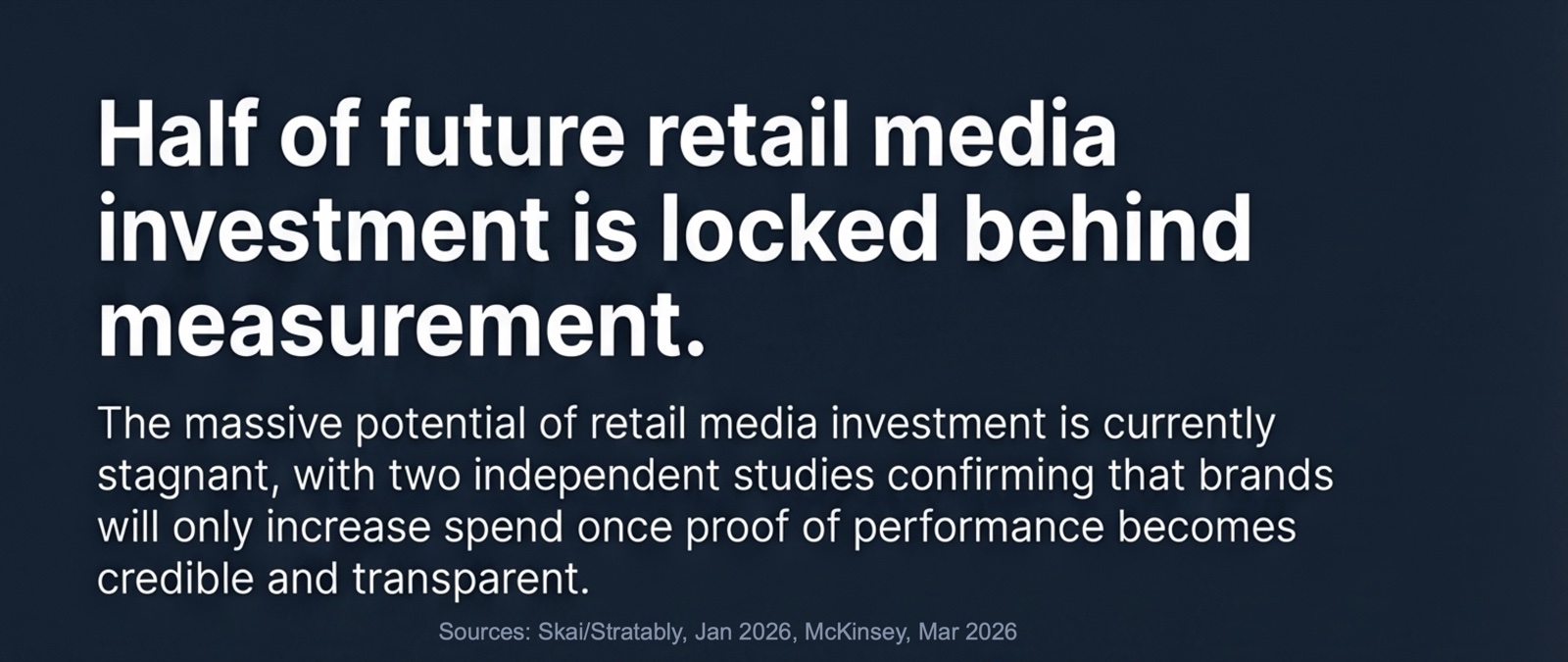
Fifty-two percent of ad buyers say better measurement would most accelerate their retail media investment (Skai/Stratably, January 2026). Separately, 50% of advertisers say improved measurement would immediately unlock incremental spend (McKinsey, March 2026). Two independent surveys. Essentially the same number. The money exists. It is waiting. It will not move until proof gets credible.
Now add delivery. Even when credible proof exists, it often arrives too late to matter. A brand’s media buyer has already planned the next flight. The agency has already reallocated. Ninety-seven percent of brand advertisers say real-time data access directly influences their investment decisions (NIQ/Coresight, 2024). The brand does not choose the better proof. They choose the proof they can actually use in their workflow.
Put a number on the operational cost. A mid-size retail media network runs roughly 50 active campaigns per quarter. At early maturity levels, each campaign report takes approximately four hours of manual assembly: pulling data from a vendor platform, exporting, formatting, delivering. At a monthly reporting cadence, that is 2,400 analyst hours per year on report assembly alone. At a fully loaded cost of $125K per analyst, that is more than one full salary consumed entirely by assembling reports that arrive too late to influence the next spending decision. Now look at what that slow delivery actually costs. If even 10% of those campaigns do not renew because proof arrived after the brand’s planning window closed, and the average campaign is worth $100K to $150K, that is $500K or more per year in revenue that never came back. Not because your proof was wrong. Because it was late.
Now add fragmentation. A brand runs campaigns across multiple ad products on your network. Each system reports through a different pipeline with a different identity backbone and a different methodology. Without a connected identity layer, you may be double-counting conversions from the same shopper in the same transaction. When a brand or agency deduplicates on their side and your numbers shrink, the credibility damage is worse than if the numbers had been lower from the start.
These three failures do not add up. They multiply. Proof that cannot be delivered when it matters does not change spending decisions. Proof delivered quickly from disconnected systems produces numbers that contradict each other. Connected systems that produce fast, consistent numbers but cannot demonstrate incrementality give brands a polished dashboard full of metrics nobody trusts. The weakest dimension constrains the other two.
And the cost is not static. It compounds on a rising timeline. In 2023, ROAS was sufficient for most brand conversations. By 2025, incrementality became the table stakes question. By 2026, cross-channel comparability is what holding companies require to include your network in their allocation models. The proof bar, the delivery standard, and the connectivity expectation are all escalating whether you keep up or not.
HOW THE RUBRIC WORKS
This rubric is built on a simple premise. Measurement maturity is not one thing. It is three things, and they are independent of each other.

The first dimension is proof capacity. What can you prove, and to whom? Can you demonstrate that an advertiser’s spend on your network drove an incremental outcome? Can you defend that proof when a brand’s analytics team pressure-tests it? Can you produce evidence that survives translation into a holding company’s cross-channel allocation model? Proof capacity is about what your measurement can demonstrate, not what data you collect.
The second dimension is operational delivery. Can you get that proof into the hands of the person who needs it, in the format they require, at the speed their decisions demand? A credible incrementality analysis that arrives six weeks after a campaign ended did not inform the next spending decision. It informed nothing. Delivery determines whether proof changes behavior or sits in a file nobody opens.

The third dimension is ecosystem unification. Are the systems producing your proof actually connected to each other, and are they connected to the rest of the retailer’s business? A brand runs sponsored products, onsite display, offsite programmatic, and CTV on your network. If each ad product reports through a different system with a different identity backbone and a different methodology, you cannot answer the most basic portfolio question: did these formats work together, or did they cannibalize each other? Unification determines whether your proof tells a coherent story across your full channel portfolio, or only works one ad product at a time.
Each dimension operates on five levels of maturity.
Level 1: Fragmented. You have ad products in market, but measurement is borrowed, manual, or disconnected. Each channel operates in isolation. There is no organizational ownership of methodology, delivery infrastructure, or data connectivity.
Level 2: Standardized. You started building your own measurement, reporting, or connections, but each ad product did it independently. You have more data than Level 1 and less clarity, because now you can see the contradictions, the delivery gaps, and the disconnections you could not see before.
Level 3: Connected. You achieved something real for at least one ad product, maybe two. Credible proof, fast delivery, or a working connection between formats. This is a genuine milestone. The problem is you only have it for a portion of your business. The rest of your portfolio is still at Level 1 or Level 2.
Level 4: Integrated. You have capability across your portfolio. Proof, delivery, or connectivity spans most of your ad products. But the system was built to serve your operations, not your audiences’ requirements. Your methodology does not translate externally, your delivery does not match their decision cadence, or your identity orchestration still has gaps that limit the cross-format story.
Level 5: Unified. Your measurement is not just credible, fast, or connected. It is portable. It travels outside your walls. Agencies can use it in their models. Brands build their workflow around it. Your proof, your delivery infrastructure, and your connected ecosystem become competitive advantages that attract dollars rather than defend them.
Those five levels apply to every dimension. But here is what makes the rubric work in practice: you do not score your organization once. You score each ad product, across each dimension, independently. Your sponsored products might sit at Level 4 on proof capacity, Level 3 on delivery, and Level 3 on unification. Your CTV might be at Level 1 across all three. Your social activations might not register on the scale yet.
That unevenness is not a failure. It is the starting point. And the minimum score across all three dimensions, for any given ad product, determines what proof can actually reach the person making the spending decision and change their behavior. The chain does not average. It breaks at the weakest link.
The chain does not average. It breaks at the weakest link.
GOING DEEPER: THE THREE DIMENSIONS OF MEASUREMENT MATURITY
Each dimension has its own thesis paper that breaks down the cost in detail, walks through all five levels with lived-experience descriptions at every stage, surfaces the portfolio question, and lays out the benefit of getting it right.

Click above to read the full Proof Capacity thesis paper.
Click above to read the full Operational Delivery thesis paper.
Click above to read the full Ecosystem Unification thesis paper.
WHERE TO START
Three dimensions. Five levels each. Scored per ad product. That can feel like a lot to hold at once. But the rubric simplifies to one question: where is your weakest link?
Find the ad product that matters most to your growth plan. Score it honestly across all three dimensions. The lowest score is your constraint. Not the dimension where you are strongest. The one where the gap is costing you the most.
These three dimensions are not a checklist where advancing each one independently adds up to maturity. They are a chain. A retailer at Level 4 on proof and Level 4 on delivery but Level 1 on unification does not have a “two out of three” profile. They have a Level 1 constraint on whether the other two can function across their portfolio.
No published maturity model organizes around these three dimensions simultaneously. No published model asks who the proof must convince, whether the infrastructure can deliver it, and whether the systems producing it are actually connected. That gap is why this framework exists.
Start with the dimension where your weakest link sits. That is where the highest-leverage investment lives.
Start with the dimension where your weakest link sits. That is where the highest-leverage investment lives.
Why I Do This Work
I’m Jaiah Kamara, founder of Signal to Summit.
I spent fifteen years in retail, seven of those years in central leadership roles building the reporting and measurement infrastructure at a top-ten retail media network. I built systems that drove advertiser confidence: reliable reporting infrastructure, decision frameworks that empowered action, operating models that ensured data quality, and cross-functional ways of working that aligned sales, strategy, and measurement around shared truth.
I now work as an industry analyst and advisor helping retail and commerce media platform providers and operators move this industry forward. I commission structured research that fills the gaps published frameworks miss, and I publish what I find so the industry can move together.
The Signal to Summit Difference
Most of my work in retail media was not about strategy decks. It was about building systems that drove advertiser confidence and organizational readiness. The Signal to Summit Measurement Maturity Framework is one of those systems, made portable for the industry.
If you are a retail or commerce media operator, platform provider, or holding company partner, and any of what you read above lands on something you are navigating right now, the path to talking is short.
Keep Reading
June 1, 2026
Ecosystem Unification: The Third Dimension of Measurement Maturity
Defined by whether your measurement holds together across the whole portfolio, or only works one channel at a time.
April 28, 2026
Operational Delivery: The Second Dimension of Measurement Maturity
Defined by whether your proof gets there in time to matter.
April 21, 2026
Proof Capacity: The First Dimension of Measurement Maturity
Defined by what your measurement can demonstrate, and to whom.