
Proof Capacity: The First Dimension of Measurement Maturity
Jaiah Kamara, Founder, Signal to Summit | 7 Years Building Measurement at Best Buy Ads | Industry Analyst and Advisor to Retail Media Platform Providers
Part 1 of 3 in the Signal to Summit Measurement Maturity series.
The Signal to Summit Measurement Maturity series begins with a question that determines whether everything else in your measurement function actually matters: can you prove value to the people spending money with you? Not what capabilities you have built. Not what technologies you have adopted. Whether your measurement produces evidence that survives the scrutiny of a brand’s analytics team, a holding company’s allocation model, or your own finance leadership. That question is the foundation of this framework, and proof capacity is where it begins. If you want the full context before going deeper, the series introduction covers the origin of that research, how the three dimensions work together, and the weakest-link principle that ties the rubric into a single diagnostic. If you are already there, let’s go.
If you have not read the series introduction, Measurement Maturity: A Framework for Retail and Commerce Media, that is the entry point to the full framework.
- The Cost of Not Getting Proof RightFour compounding revenue consequences when proof cannot survive scrutiny
- Five Levels of Proof CapacityFrom Flying Blind to Proof That Travels, scored independently per ad product
- The Portfolio QuestionWhy your weakest ad product determines what your strongest can earn
- The Benefit of Getting Proof RightRetention compounds, national budgets unlock, and finance stops asking the cannibalization question
- What Comes NextOperational delivery determines whether proof reaches the person making the spending decision
THE COST OF NOT GETTING PROOF RIGHT
Proof failure is not an abstract measurement problem. It is a revenue problem with compounding consequences. The cost operates at four levels, each escalating in severity.
First, brands refuse to recommit. When a brand advertiser finishes a campaign and the best you can deliver is a self-attributed ROAS number they did not build and cannot verify, the conversation about the next campaign starts from skepticism. The brand does not cancel loudly. They hold flat in the next JBP cycle, or they shift dollars to a network that gave them a credible story. Forty-four percent of brand advertisers cite accuracy and reliability as their top measurement frustration (Bain/ANA, 2024). That frustration translates directly into smaller renewals and shrinking deal sizes.
Second, the proof language itself is fractured. The industry cannot even agree on what “incremental” means. The ANA and ARF identified ten distinct definitions of incrementality in use across the industry, with only 48% maximum agreement on any single definition (ANA/ARF, 2024). When a brand asks you to prove incrementality and your definition does not match theirs, the conversation stalls before the data is even reviewed. Proof that uses language the audience does not share is not proof. It is a misunderstanding waiting to erode trust.
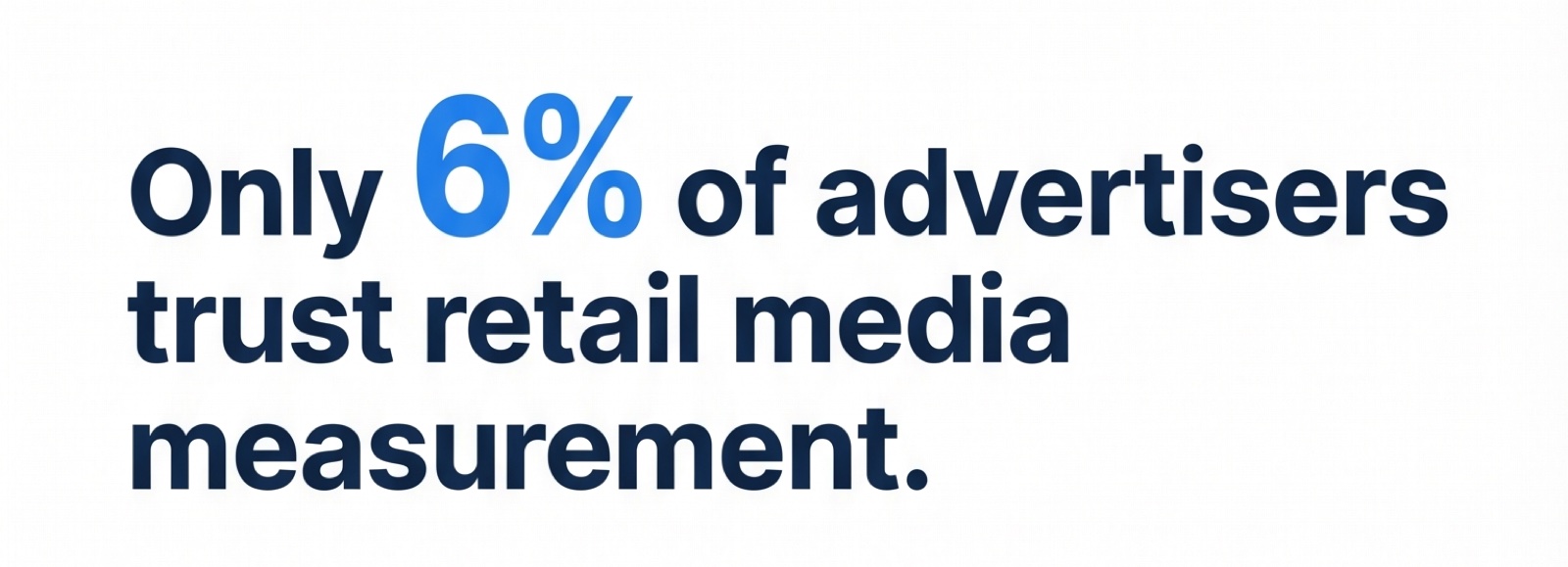
Third, the trust deficit is nearly universal. Only 6% of advertisers trust retail media network measurement (Bain, 2024). Ninety-four percent of the brands spending money on your network have reservations about the numbers you are giving them. That is not a gap to close. That is a foundation to rebuild.
Fourth, half of your future revenue is locked behind proof you cannot yet deliver. Fifty-two percent of ad buyers say better measurement would most accelerate their retail media investment (Skai/Stratably, January 2026). Separately, 50% of advertisers say improved measurement would immediately unlock incremental spend (McKinsey, March 2026). Two independent surveys. Essentially the same number. The money exists. It is waiting. It will not move until proof gets credible.
And these costs compound commercially. If your existing advertisers cannot get credible proof that their spend worked, they will not increase their investment. You are stuck defending last quarter before you can sell next quarter. Meanwhile, national media budgets, five to ten times larger than trade and shopper budgets, stay out of reach because those dollars flow through holding company media allocators who require proof at a standard most networks cannot meet. Your sales team feels it every cycle. More time defending. Less time expanding. The narrative shifts from growth to justification.
The proof bar is not static. It rises every year. In 2023, ROAS was sufficient for most brand conversations. By 2025, incrementality became the table stakes question. By 2026, cross-channel comparability is what holding companies require. Standing still on proof capacity means falling behind, because the standard advertisers apply is escalating whether you keep up or not.
FIVE LEVELS OF PROOF CAPACITY

Level 1: Flying Blind. You launched retail media. You have ad products in market. Brands are spending. But when someone asks “did this work,” you are pulling a screenshot from a vendor dashboard or a platform report that your team did not build, does not control, and cannot explain. The number on the screen might say 4x ROAS, but you do not know what went into it. You do not know the attribution window. You do not know if it deduplicated across your other ad products. You are borrowing someone else’s proof and hoping nobody asks a hard question.
This is true across your entire portfolio. Your sponsored products report through one vendor. Your onsite display reports through another. Your offsite programmatic partner sends a weekly summary your team pastes into a deck. If you have CTV, the streaming partner provides their own numbers on their own timeline. Social activations come back as platform-reported aggregates you cannot verify. Paid search runs through an auction system with its own conversion logic. Each channel hands you a number. None of them talk to each other. Nobody on your team is running their own tests. The concept of measuring incrementality has not entered the conversation, because no dashboard number has been challenged yet.
Why: You do not own the methodology producing the data in any channel. Each vendor or partner chose its own attribution window, conversion logic, and deduplication approach. Your sponsored products vendor made one set of choices. Your offsite DSP partner made different ones. Your CTV partner made yet another. You have no visibility into any of these choices, and no ability to compare across them, because they were never designed to be compared. The number could be 4x or 2x depending on settings you never selected and cannot change. Until you own the methodology, you cannot interrogate the output. Which means you cannot defend it when someone does. Incrementality testing, media mix modeling, none of it exists here, not because it is too advanced, but because there is no organizational demand for it yet. The self-attributed numbers stand unchallenged, channel by channel, in mutual isolation.

Level 2: Numbers That Disagree. You started building your own measurement. You have reports. Maybe multiple reports. The problem is they do not agree with each other. Your sponsored products team has one set of numbers. Your offsite partner has another. Your analytics team ran something that contradicts both. When a brand asks for results, the answer depends on who pulls the report.
And it is not just the legacy formats. Your CTV partner sent a post-campaign report with reach and frequency metrics that do not map to anything your onsite team measures. Your paid search numbers live in the auction platform’s interface, using its own conversion logic. Social activations came back as aggregated platform reporting with no shopper-level detail. Someone on your team started running lift studies, maybe because a brand demanded it, maybe because leadership wanted a proof point. But each study used a different methodology. One was exposed-versus-unexposed on a 14-day window. Another was a geo-holdout your offsite partner ran on their side. The results do not agree with each other, and neither agrees with the dashboards. You have more data than Level 1, but less clarity, because now you can see the contradictions you could not see before.
Why: Each team or ad product built measurement independently. Sponsored has one attribution model. Offsite uses a partner’s methodology. CTV reports on reach and frequency using the streaming partner’s impression data. Paid search runs on the auction platform’s own conversion tracking with its own attribution window. Social returns cohort-level aggregates from inside a walled garden. There is no governance layer deciding which methodology is authoritative for which question. No one has defined what “incremental” means for your organization. No one has aligned attribution windows across ad products or across channels that were never designed to share a common measurement language.
The lift studies arriving at this stage compound the problem. Each one makes independent choices about audience definition, conversion window, and holdout design. They are not comparable to each other, and none is comparable to the always-on dashboard metrics. MMM has not entered yet because it requires historical data at sufficient depth, outcome data at the right granularity, and statistical expertise the team has not built. The instinct to prove incrementality has arrived. The infrastructure to do it consistently has not.

Level 3: You Can Prove It for One. You have a credible proof story for at least one ad product, maybe two. Your sponsored products have a clean attribution methodology your team controls. Or you ran a series of incrementality tests for your onsite display that held up when the brand’s analytics team reviewed them. When a client asks “did this work” for that format, you have an answer you can stand behind.
The rest of your portfolio is a different story. Your offsite display is still running on a partner’s dashboard. Your CTV measurement is borrowed from the streaming partner’s reporting. Your in-store media, if you have it, has almost no measurement to speak of. Social activations return platform aggregates. Paid search lives in the auction interface. The proof story that works for one or two formats does not transfer to the rest. When a brand asks for a cross-portfolio view, you give them your strong format and describe the others at a much lower confidence level.
Why: The team that built strong proof for one ad product made deliberate choices. They standardized an attribution window. They built or licensed a methodology they control. They ran tests consistently enough to generate a track record. That discipline does not automatically transfer to other ad products. Each new format requires a separate effort to build the measurement foundation, and most organizations at this stage have not made that investment broadly.
The structural gap is data pipelines. Your strongest format has a clean data pipeline from ad exposure to outcome. Your weaker formats do not. CTV exposure data lives with the streaming partner. In-store activation data is often disconnected from transaction data. Offsite match-back runs through a partner with variable match rates. Each gap is a place where the proof chain breaks. MMM may be arriving at this stage, particularly for the formats where enough historical data exists, but it is not yet calibrated across your portfolio. Incrementality testing is ad hoc: strong for the format you prioritized, absent or inconsistent for the rest.

Level 4: Proof Across the Portfolio, on Your Terms. You can produce credible proof across most of your ad products. Sponsored, onsite display, offsite, CTV, paid search, social, in-store. Each format has a measurement methodology your team controls, and the methodologies are consistent enough that you can compare performance across formats without the numbers contradicting each other in ways you cannot explain.
But the proof works on your terms. Your attribution windows, your conversion definitions, your identity resolution approach. When a brand’s analytics team or a holding company media allocator evaluates your numbers against the standards they apply across their other media investments, gaps appear. Your methodology does not map cleanly to how they measure performance on linear TV, social, or programmatic. Your identity resolution approach has coverage limitations that compress your numbers when they run their own match. Your incrementality methodology is sound internally but not transparent enough for an agency to evaluate independently. You can prove it. You cannot always prove it in a format the audience can act on.
Why: Each format’s proof story was built to serve your reporting needs, not your audiences’ evaluation needs. Attribution windows were set to maximize match rates, not to align with how brands measure across channels. Incrementality methodology was designed to be defensible internally, not transparent externally. Identity resolution was built on your loyalty backbone, which is strong for your shoppers but not designed to interoperate with the clean room frameworks agencies use to normalize across networks.
MMM is active at this level and calibrated well enough across your portfolio to provide directional confidence. Experimentation is systematic: you run holdout tests regularly, across most formats, with consistent methodology. But the results live inside your system. They are not structured for external consumption. A holding company allocator cannot take your MMM output and run it through their cross-channel model without significant translation work. That translation friction is the gap between Level 4 and Level 5.
Level 5: Proof That Travels. Your proof does not just satisfy internal stakeholders. It survives external scrutiny. A brand’s analytics team can evaluate your methodology, understand your attribution logic, and assess your incrementality evidence without taking your word for it. A holding company media allocator can take your measurement output and run it through their cross-channel model without rebuilding it from scratch. Your proof travels outside your walls and holds up when it gets there.
This is true across your full portfolio. Sponsored, display, offsite, CTV, paid search, social, in-store, non-endemic. Each format has a measurement approach that is documented, transparent, and designed to interoperate with the frameworks your audiences use. When the numbers get pressure-tested, they hold. When the methodology gets audited, it passes.
Your proof no longer depends on any single methodology. Your MMM, your experimentation program, and your attribution data cross-reference each other continuously. When one says a campaign drove lift, the others confirm or flag a discrepancy that triggers recalibration. This triangulation works across your full channel portfolio. For channels where traditional holdout tests are not feasible, synthetic controls construct counterfactual baselines so proof coverage extends across formats that would otherwise have gaps. You can tell a brand before they commit budget where their next dollar will generate the most incremental return across your network, because the model’s forward estimates have been validated against enough real-world outcomes to carry credible confidence intervals. For non-endemic advertisers with no transaction in your system, you have systematized alternative proof paths: brand lift, audience qualification, foot traffic attribution, third-party conversion tracking. Those paths are not as clean as transaction-based measurement, but they are productized and transparent rather than ad hoc.
At this level, measurement is not a cost center or a defensive function. It is an acquisition tool. Brands and agencies actively seek your network out because your proof makes their jobs easier. You are not defending your numbers. You are attracting new dollars because the proof does the selling.
Why: Three things are true that were not true before. First, your methodologies are documented and transparent across every channel. An agency can see the attribution logic, the identity resolution approach, and the incrementality methodology for each format, and evaluate them on their merits rather than taking your word for it. Second, your proof is portable. It can enter a holding company’s media mix model or cross-channel allocation framework without requiring translation or discounting, whether the format is onsite, offsite, CTV, social, or in-store. Third, no single methodology carries the burden of proof. Your MMM, your experimentation program, and your attribution data triangulate continuously. When two independent methodologies with different assumptions arrive at the same conclusion, the proof is stronger than either one alone. When they diverge, the system self-corrects.
Predictive allocation models are possible here because the calibration history is deep enough across your portfolio that the model projects forward with credible confidence intervals. Synthetic controls extend proof coverage to campaigns and formats where holdout designs are not feasible, constructing counterfactual baselines from historical patterns rather than requiring audience exclusion. Non-endemic proof paths are systematized because the entire measurement architecture from Level 1 through Level 4 was built on a transaction backbone that does not serve advertisers with no purchase in your system. The collective shift, triangulation, prediction, synthetic controls, non-endemic proof paths, moves measurement from proving what happened to advising what should happen next. That is what makes proof travel. It is not just credible and portable. It is actionable before the money is spent.
THE PORTFOLIO QUESTION
Here is what most people miss. You do not sit at one level as an organization. You sit at different levels for different ad products. Your sponsored products might be at Level 4. Your offsite display might be at Level 2. Your in-store media might be at Level 1. And that unevenness is not just an operational inconvenience. It is the thing that breaks your proof story when it matters most.
Think about the last time a brand or agency asked you for a cross-portfolio view of performance. They did not ask “how did sponsored products do.” They asked “how did your network perform.” The answer to that question is only as strong as your weakest ad product. If your sponsored products are producing credible, defensible incrementality evidence but your offsite display is still running on a partner’s unverified dashboard numbers, the portfolio story collapses to the level of the weakest link. The agency does not average your best and worst. They discount the whole thing.
And here is the part that makes this urgent. The ad products generating the most revenue today are usually the ones with the strongest proof. But the ad products with the most growth potential, offsite, in-store, emerging formats, are usually the ones with the weakest proof. Your growth roadmap and your proof capacity are pointing in opposite directions. The part of your business you are counting on to grow is the part least equipped to earn the investment it needs to get there.
That is why this is not a single score. It is a portfolio question. Where does each ad product sit? Which one is the weakest link? And is that weak link sitting on the part of your business you need to grow the most?
THE BENEFIT OF GETTING PROOF RIGHT
You just walked through five levels. You found yourself somewhere on that spectrum. Maybe your sponsored products are at Level 4 and your offsite display is at Level 2. Maybe your entire portfolio is at Level 3, with one strong proof story and everything else running on borrowed numbers. Wherever you are, here is what changes when you move up.
First, retention compounds. When your proof is credible, brands stop questioning whether to come back. Renewals grow. Deal sizes increase. Your sales team shifts from spending half their time defending last quarter’s results to spending that time expanding the relationship. The energy that was going into justification goes into growth instead.
Second, you unlock a budget pool you have never accessed. Right now, most retail media dollars come from trade and shopper marketing budgets. Forrester found that 62% of retail media spend is reclassified from those existing buckets (Forrester, 2024). Those dollars were already in the retailer’s P&L. National media budgets, the dollars brands spend on linear TV, social, and programmatic, are five to ten times larger. But those dollars flow through holding company media allocators who require proof at a standard most retail media networks cannot meet today. When your proof reaches Level 5, when it is transparent, portable, and methodologically defensible, you are competing for dollars that were never on the table before.
Third, the revenue story changes for your finance leadership. When your retail media business grows by pulling from trade and shopper budgets, finance sees an accounting shift, not new revenue. The money was already in the building. But when you attract national media dollars because your proof earned them, that is genuinely incremental contribution. The internal coalition holds because the numbers tell a growth story, not a reclassification story. Finance stops asking whether retail media is cannibalizing existing relationships and starts asking how fast it can scale.
That is the proof capacity dimension. Where you sit on that spectrum determines whether you can answer the most important question any advertiser, agency, or internal stakeholder will ask: did this work, and can you prove it?
WHAT COMES NEXT
But proof that exists is only half the equation. The other half is whether you can deliver that proof at the speed, in the format, and at the access level each audience requires to actually act on it.
A brand advertiser who gets a credible incrementality report six weeks after the campaign ended cannot use it to optimize the next flight. A holding company media allocator who has to manually request data through your account team cannot include your network in their real-time allocation model. A retailer finance leader who sees quarterly rollups instead of continuous revenue signals cannot make the case for investment at the pace the business requires.
Proof that cannot be delivered when it matters does not change spending decisions. It just sits in a dashboard nobody opens.
That is what comes next: Operational Delivery: The Second Dimension of Measurement Maturity. How fast can you get proof into the hands of the person who needs it? In what format? At what level of access? And what does it cost you when the answer is not fast enough?
If you have not read the series overview, Measurement Maturity: A Framework for Retail and Commerce Media, that is the entry point to the full framework.
Why I Do This Work
I’m Jaiah Kamara, founder of Signal to Summit.
I spent fifteen years in retail, seven of those years in central leadership roles building the reporting and measurement infrastructure at a top-ten retail media network. I built systems that drove advertiser confidence: reliable reporting infrastructure, decision frameworks that empowered action, operating models that ensured data quality, and cross-functional ways of working that aligned sales, strategy, and measurement around shared truth.
I now work as an industry analyst and advisor helping retail and commerce media platform providers and operators move this industry forward. I commission structured research that fills the gaps published frameworks miss, and I publish what I find so the industry can move together.
The Signal to Summit Difference
Most of my work in retail media was not about strategy decks. It was about building systems that drove advertiser confidence and organizational readiness. The Signal to Summit Measurement Maturity Framework is one of those systems, made portable for the industry. The proof capacity dimension you just walked through is one piece of it.
If you are a retail or commerce media operator, platform provider, or holding company partner, and any of what you read above lands on something you are navigating right now, the path to talking is short.
Keep Reading

June 1, 2026
Ecosystem Unification: The Third Dimension of Measurement Maturity
Defined by whether your measurement holds together across the whole portfolio, or only works one channel at a time.

April 28, 2026
Operational Delivery: The Second Dimension of Measurement Maturity
Defined by whether your proof gets there in time to matter.
April 14, 2026
Measurement Maturity: A Framework for Retail and Commerce Media
Defined by what you can prove, deliver, and unify.